THE FABRIC OF MEMORY
Costume, History and the Cinematic Image in The Colour of Pomegranates
10 September 2024
Iva Kontic
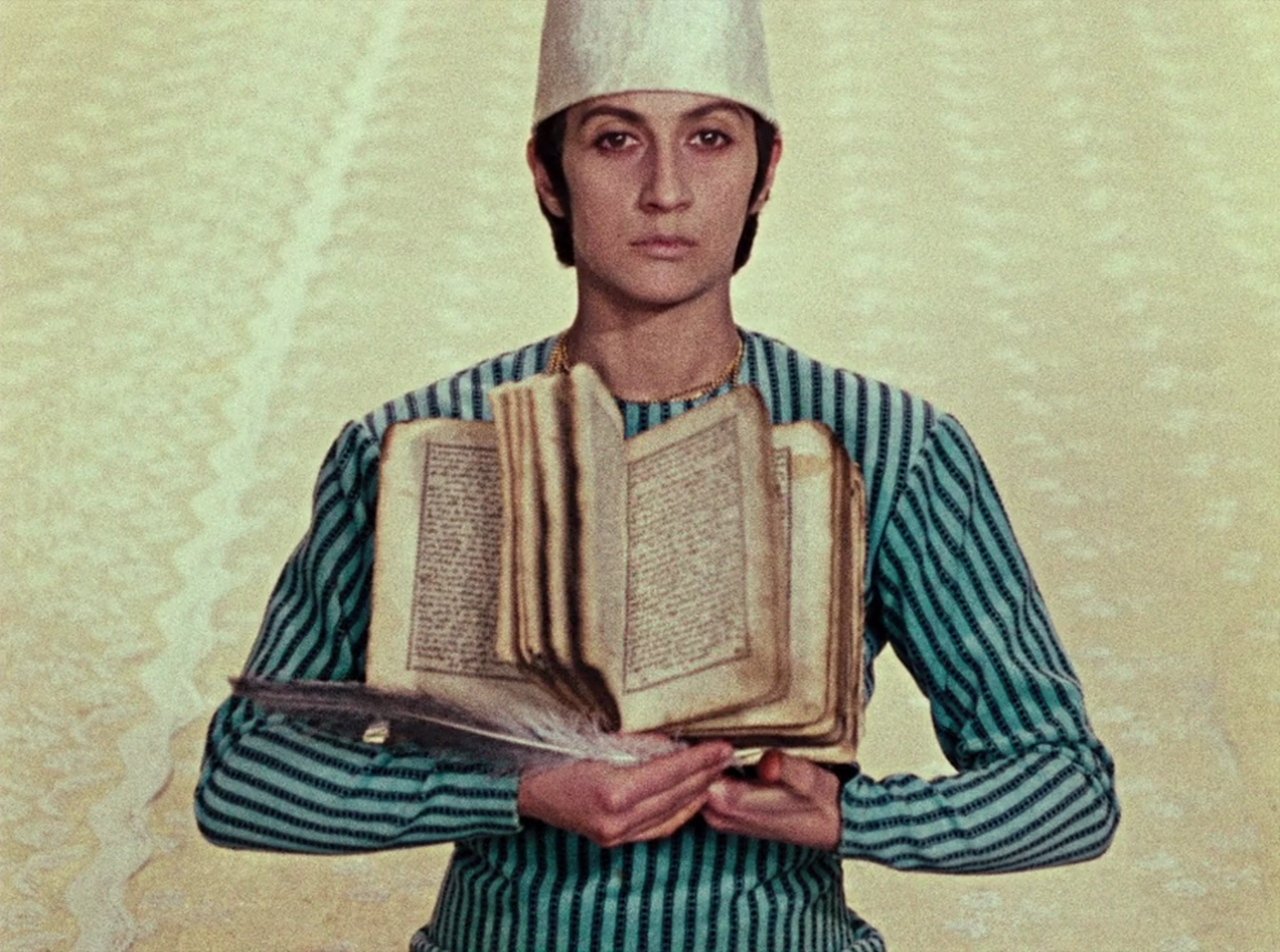
In The Colour of Pomegranates (1968), Sergei Parajanov’s avant-garde film on the life of the eighteenth-century Armenian poet Sayat-Nova, costume is never mere decoration. I explore some of the key characteristics and functions of costume design in the film—the avant-garde work by the Armenian director. I try to define how the costume, conceived in the context of the film as a set of clothes, accessories, embroidery, textiles and colours, plays an essential role in constructing the film’s narrative and forming its audio-visual language and style. The costume’s specific reference to Armenian cultural heritage and history, and its particular use in the construction of the cinematic image, make it become a generator of the film’s powerful synesthetic effect and highly symbolic yet enigmatic meaning. I attempt to show that the film’s costume design isn’t just an integral part of filmmaking, the essential constituent of cinematic image and language; in The Colour of Pomegranates, it is recognised as a core agent of our reconnection to history, seen as collective memory through the cinematic experience.
When it comes to analysing the complex presence and role of costume in The Colour of Pomegranates, it is important to mention that the film was first conceived as a biopic about the eighteenth-century Armenian poet and singer Sayat-Nova, who was considered a historical figure central to the formation of Armenian cultural identity as well as to the multicultural Transcaucasian heritage. Released within the context of the USSR political and cultural reality, the film was criticised and censored by the local cinema regulatory body for not being realistic enough to qualify as a biographical film and, more broadly, as a historical film. Consequently, all the references to Sayat-Nova had to be removed from the film, including the quotations from his songs in the intertitles (except those directly integrated into the film’s scenes through the words sewn on the pieces of cloth) — making the film even more abstract and non-conventional in relation to its historical source and original film genre.¹
Citing the films of Tarkovsky and Pasolini as his main sources of inspiration, Parajanov’s filmmaking was marked by an attempt to escape the classical Soviet cinema realism, its rationalist and modernist approach, by infusing the cinematic image with surrealist moments and creating a stream-of-consciousness effect.² This surrealist, non-realistic approach to representing a historical figure, and therefore a historical moment, through mainly visual and sonic qualities of the image takes up the centre stage in The Colour of Pomegranate. The film abandons the traditional fabula of the historical genre, substituting actual historical events with poetry, ethnography, songs, performance and archaeology—and thus it “transforms a narrative retracing of history into an affective event.”³
This is where the costume design plays the essential role, since “it functions as both realism and spectacle.” Sarah Street recognises it as a part of “complex codes of verisimilitude which films use in order to convince (…) their audience, which either accord with a notion of generic verisimilitude as part of genre iconography, or with a notion of social verisimilitude (…)—costumes that convince as being realistic to appropriate situation” (in this case, appropriate to the historical circumstances outlined by the biopic).⁴ We can say that Parajanov’s ‘visual poem’ overturns this standard conception of ‘verisimilitude’ hierarchy between costume and film genre. Since the film’s historical (sur)realism brings to the same level the non-objective, highly symbolical and carefully constructed images in a collage style with the historical factuality they refer to, the costume and other ‘fashion objects’ actually become the markers in the film for establishing our relation to the real world, that is, to the objective historical reality.
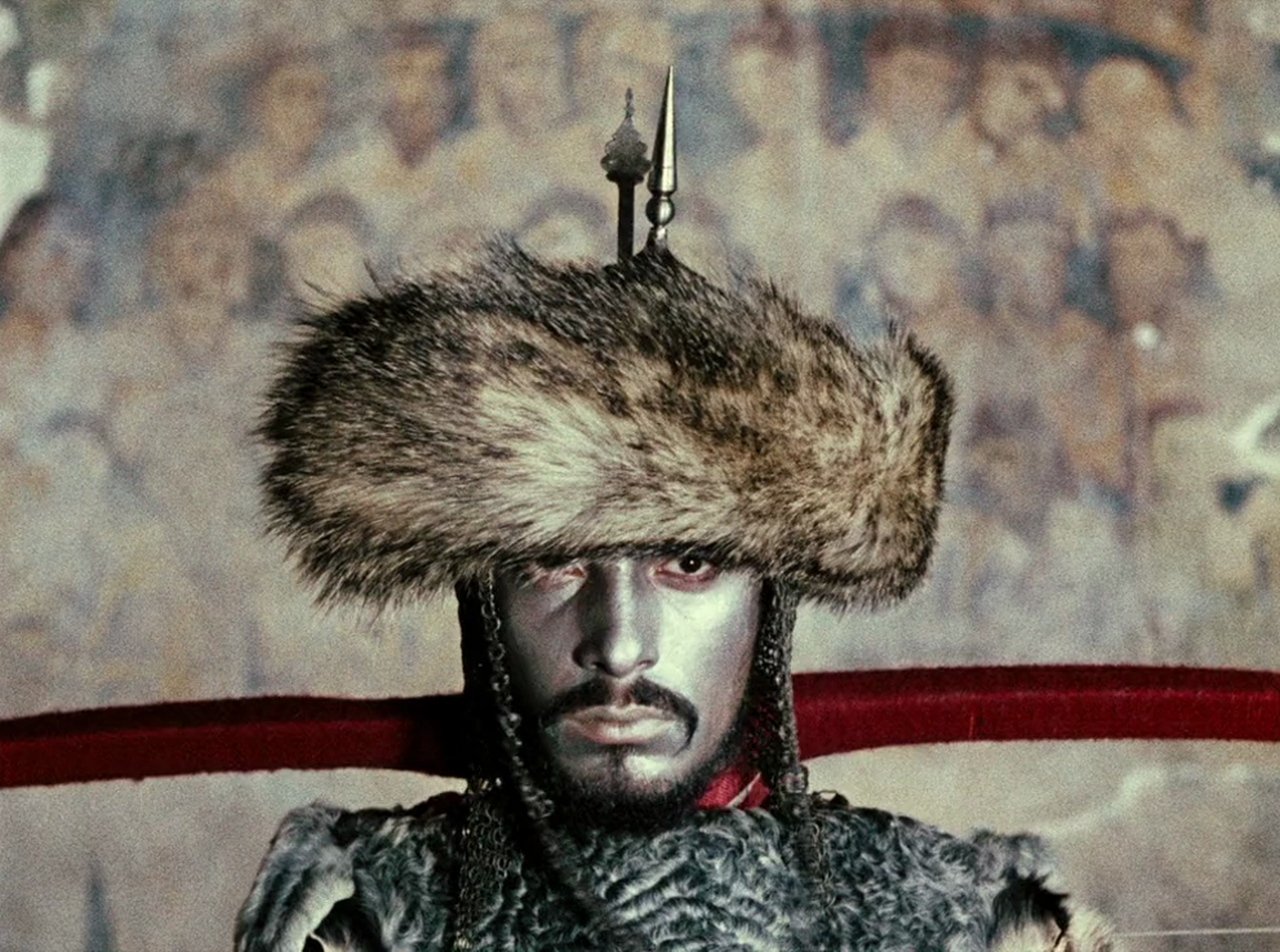
Through the complex use of ethnographic costumes, traditional clothes, accessories, cultural and religious artefacts, tapestry and different textiles representative of the Armenian national heritage, the costume design in the film evokes the Armenian cultural history (identity), which is conceived as collective memory and whose experience and continuity can be only obtained through the performance of those memories embodied in language, music, dance, secular or religious customs, architecture and, of course, clothes and ‘fashion objects’ (although we can’t properly talk of ‘fashion’ in this pre-industrial context). The Colour of Pomegranate inaugurates what Patricia Pisters outlined as “the shifted interest of cinema towards history [which,] told as past past, becomes memory, (…) a past which is problematised in the present.”⁵ The same shift has been noticed by Wortel and Smelik in postmodern costume films, which seek to “produce a different experience of memory rather than a ‘correct’ representation of the past; [they] turn to performance, texture and affect for its valuable function: cinematic performance of memory allows us to experience the lived past in our present.”⁶
In this light, Parajanov’s film represents a poetic and ethnographic reconstruction of Armenian history, cultural tradition and religious identity through synesthetic experience of colour, sound, materiality (clothes, textiles, fashion and other objects, but also landscape, animals, architecture and the materiality of the analogue film itself) and movement (performative gesture).⁷
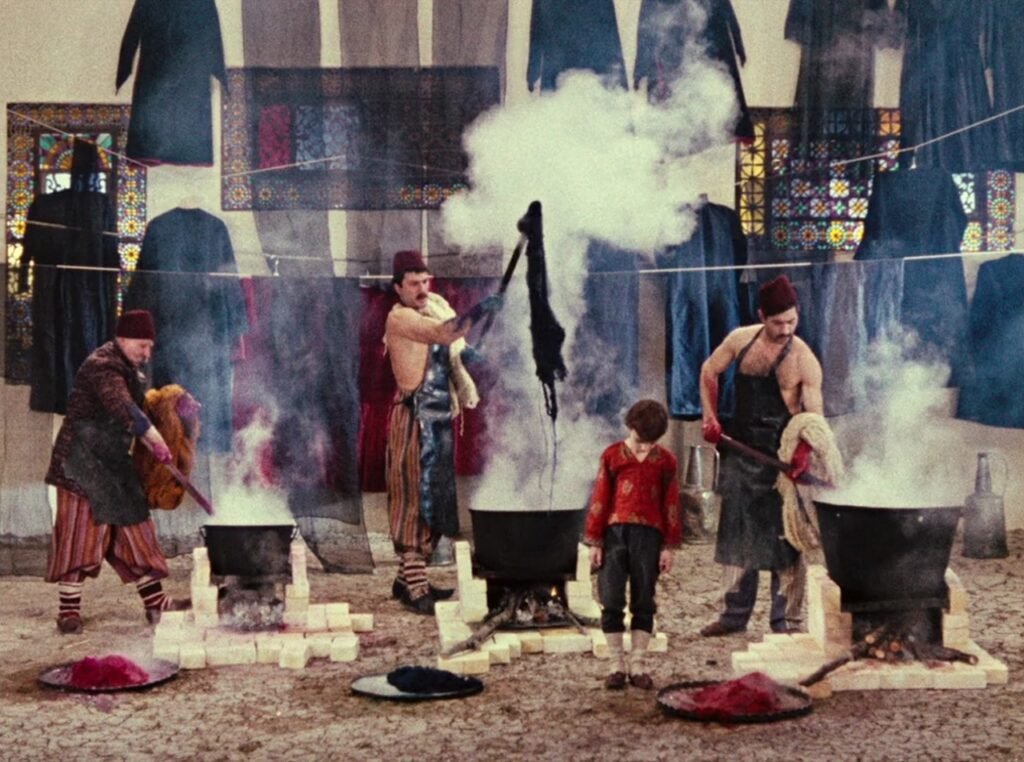
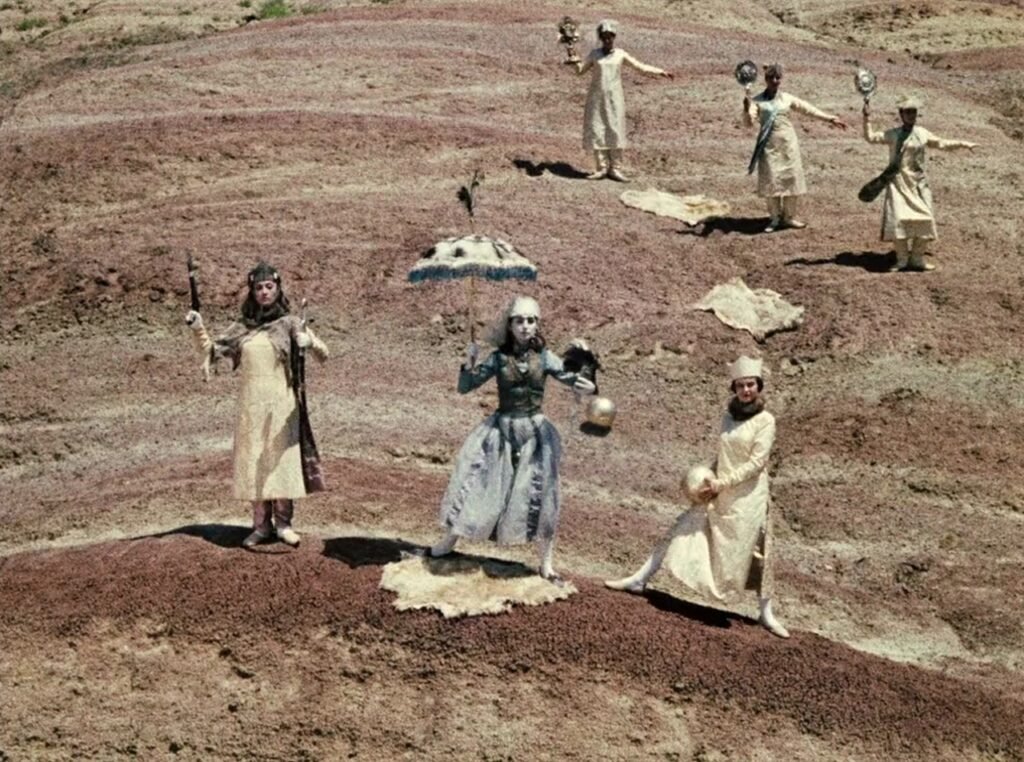
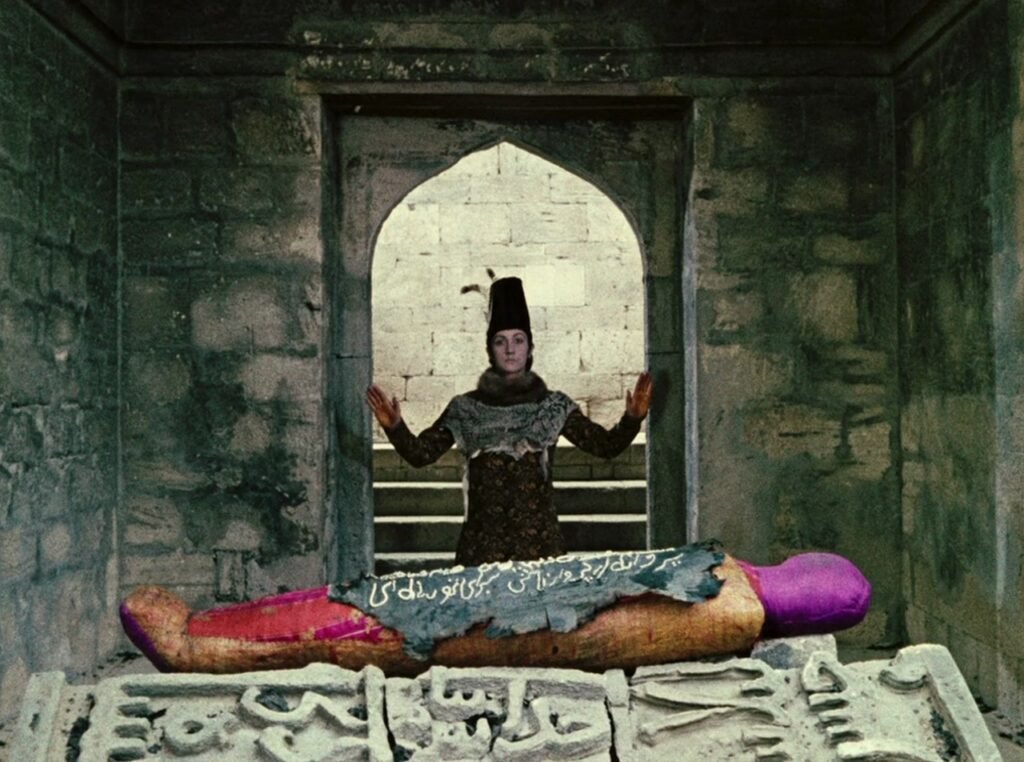
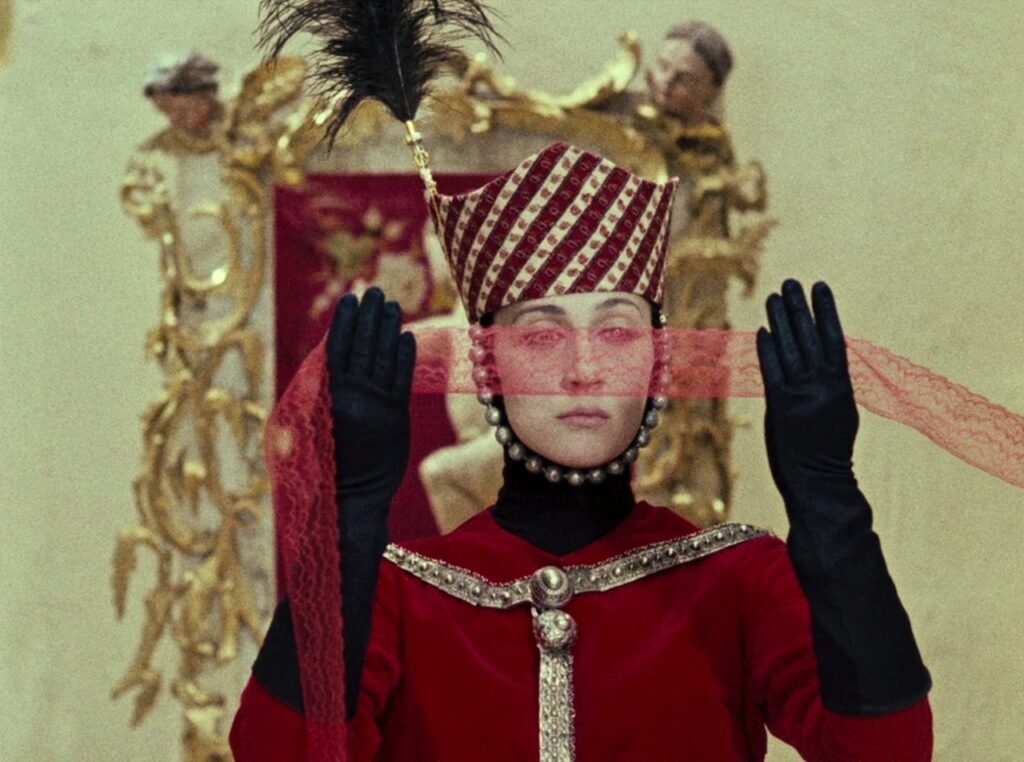
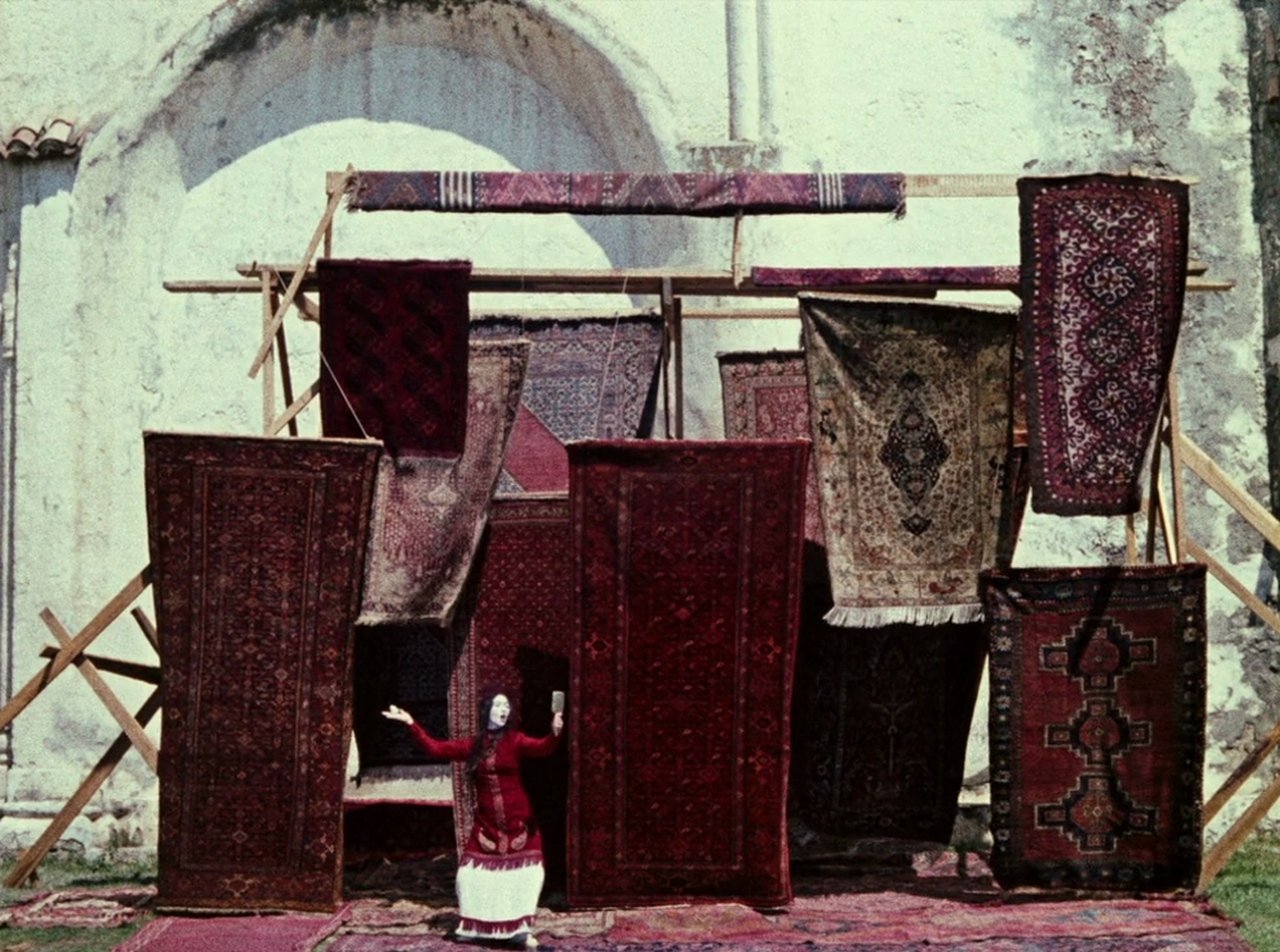
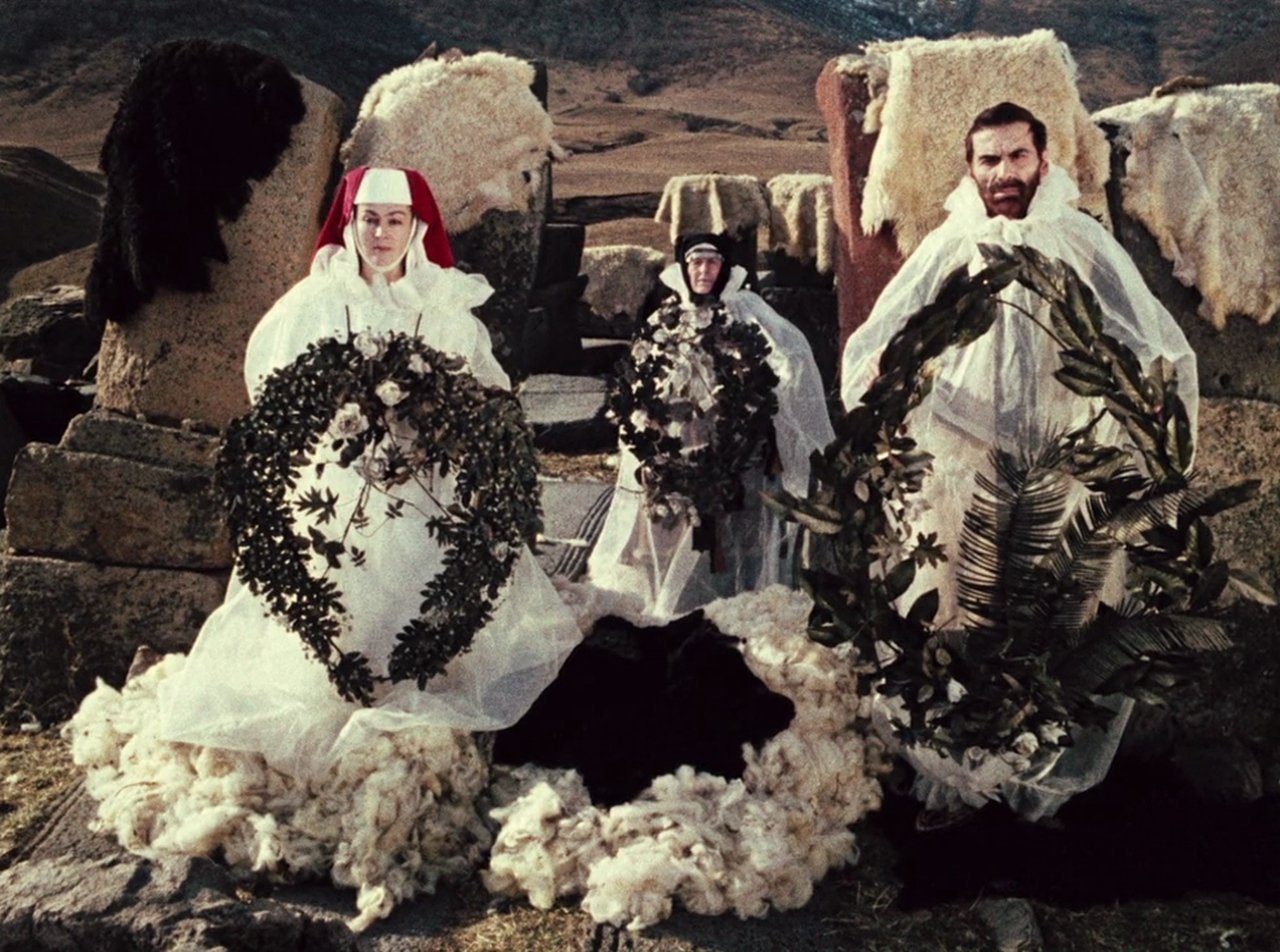
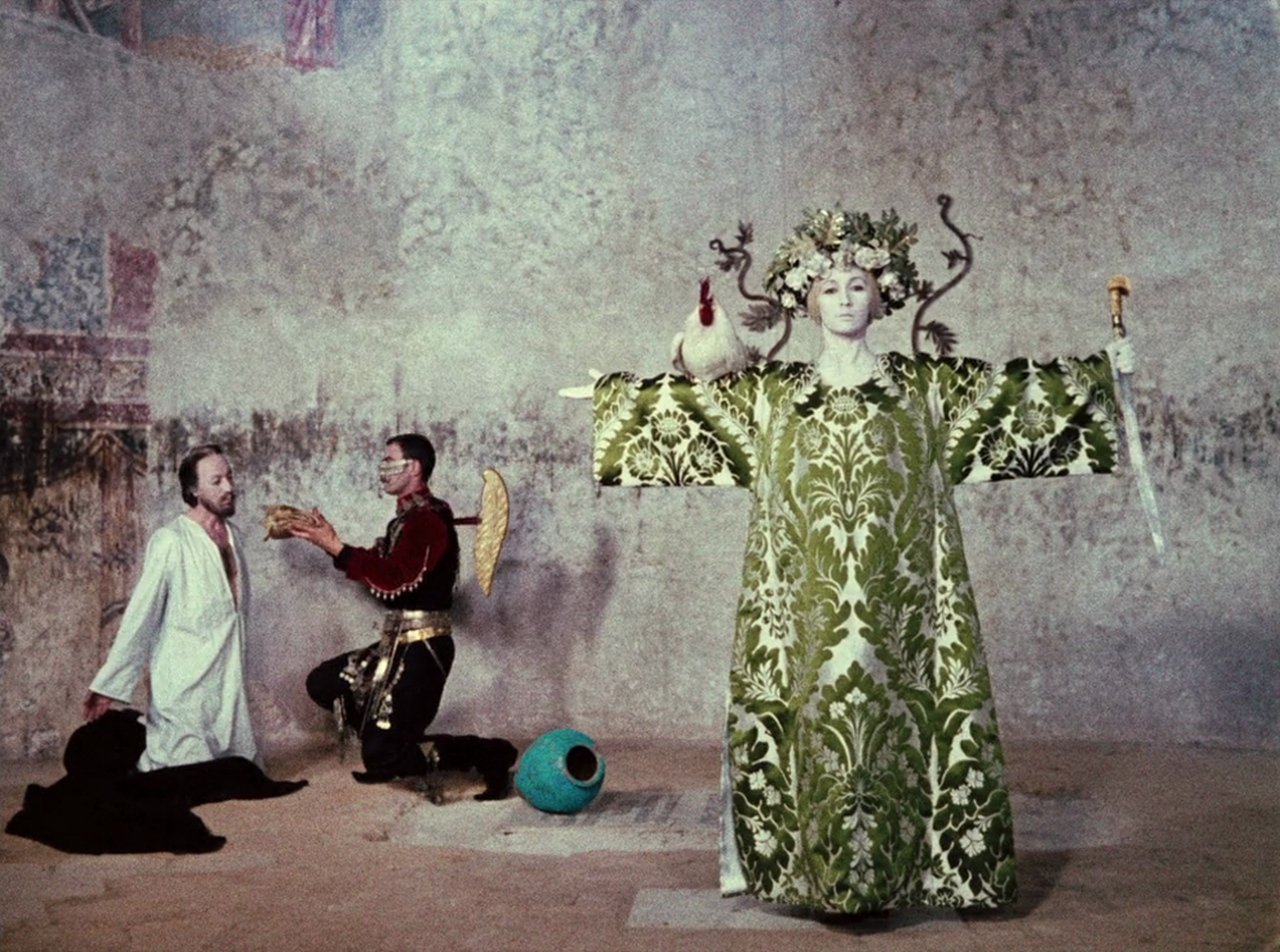
It is therefore clear how costume design here can’t be only understood as an ethnographic marker of national history and identity, the film’s realism, but as an interwoven element, the very fabric of its cinematic image, which has a strong haptic quality. This haptic sense in The Colour of Pomegranates is brought to extreme, emanating from the abundance of textiles and fabrics that constitute the costumes and other fashion objects. The materiality of the dresses, tapestries, rugs and clothes, wool, lace, jewellery, hats and other accessories is reflected to that one of the multitude of film props and symbolic objects (sheep, roosters, pomegranates, bread, grapes, books, dishes, armature, church relics, hay, earth, feathers)—and together they integrate into the materiality of the architectural sites, another important element through which the film’s meaning and esthetic value is structured.⁸
The lack of depth field in the film’s images brings all the given materialities to one single plane, which perfectly corresponds to the graininess of analogue film. Together they give the surface of the cinematic image a tactile quality, as if we were not looking at the screen but into a textile surface. As if the film itself were one of those tapestries and embroideries displayed in its tableaux-vivant-like scenes; or as if it were a Persian miniature painting referenced in the filmic construction of those ‘living pictures’, which are heavily reminiscent of early cinema (or better, prehistoric cinema). The film becomes part of that very heritage which is representative of the local cultural identity—thus evoking the materiality of collective memory.
The synesthetic concept of the poetic cinema of Parajanov, closely linked to its costume design and essential to the film’s conception of history, expands further into the sphere of the olfactory, even the gustatory, through the interaction with them (the vapor from the wool-dyeing, the red liquid (blood) in the sacrifice of lambs, the touching and kissing of earth mixed with bread, etc.). Historical reality is transformed into a synesthetic spectacle, bringing the costume’s double role in cinema—as realism and spectacle—to the equation.
The rich, complex, meticulously constructed symbology and meaning of each fashion and non-fashion object (e.g., the colours of the dyed wools indicate the Armenian flag), together with their performative interaction with the characters and their bodies, give us potential access to the film’s historical reality and its interpretation. This access seems to depend on a close knowledge of the local cultural heritage and history; yet it always leaves us ‘at the entrance’, always remaining within the realm of mystery and ambiguity. Just like the costumes, conceived by Parajanov himself⁹—therefore not authentic artefacts but sartorial pieces—this ‘poetic biopic’ short-circuits the opposing trends of modern cinema, which Bazin identified as either placing faith in the image or trusting in reality.¹⁰
By the same token, the performative aspect of the film—especially the relationship between the performing bodies and the clothes — becomes fundamental to its oscillation between different cinematographic approaches and styles, between meaning and ambiguity, reality and spectacle, cinematic narration and history. The static, pictorial reality of The Colour of Pomegranates is animated exclusively by characters’ performances, which seem shaped by the form and materiality of the garments and cloth. The abundance of fabrics, textures and colours of the latter seems to correspond to the reduction and minimalism of the former.
Similarly, the costume both supports and provokes the sexual ambiguity created by the same actress performing both Sayat-Nova and his wife (as well as several other characters). Cross-dressing and the alteration of objects that function as ‘gender-indicators’ (e.g. the shell and knitting needles) create a Deleuzian ‘mirror-image’, in which the real and the imaginary, the present and the past ‘coalesce’, distinct yet indiscernible in a state of continuous reversibility.¹¹ Together with the frequent acts of dressing, undressing, knitting, dancing with tapestry on the sound of popular Sayat-Nova music, they generate a particular performance of collective memory.
The national history and cultural identity are not simply represented and preserved but are put in the continuous “process of ‘becoming’, (…) a dynamic practice of metamorphosis”¹² where memory (or, “invention of people”¹³) continually moves between written word, artefacts, clothes, music, myths and customs, architectural ruins, geographic and political landscape, technology—between past, present and future.
Notes
² Dimitar Kutmanov, “The Cinema of Sergei Parajanov,” Dimitar Kutmanov (portfolio), accessed August 31, 2024, kutmanov.weebly.com.
⁶ Elise Wortel and Annike Smelik, “Textures of Time,” 185–200.
⁷ Ibid.
⁸ The film was shot at several historic locations in Armenia, Georgia and Azerbaijan which were important in the life of Sayat-Nova but also for the history of the Armenian people — e.g. Haghpat Monastery, where the poet-singer had lived as a monk in his later years: Curtis Tsui, “10 Things I Learned: The Color of Pomegranates,” The Criterion Collection, May 9, 2018, criterion.com/current/posts/5639.
⁹ Ibid.
¹⁰ André Bazin, What is Cinema? (University of California Press, 1967), 24.
References
—Bazin, André. What is Cinema? University of California Press, 1967.
—Deleuze, Gilles. Cinema 2: The Time Image. University of Minnesota Press, 1989.
—Kutmanov, Dimitar. “The Cinema of Sergei Parajanov.” Dimitar Kutmanov (portfolio). Accessed August 31, 2024. kutmanov.weebly.com.
—Parajanov-Vartanov Institute. “The Color of Pomegranates, a Film by Sergei Parajanov,” December 15, 2023. parajanov.com/thecolorofpomegranates.
—Pisters, Patricia. “The Open Archive: Cinema and World-Memory.” In The Neuro-Image: A Deleuzian Film-Philosophy of Digital Screen Culture. Stanford University Press, 2012.
—Street, Sarah. Costume and Cinema: Dress Codes in Popular Film. Wallflower, 2002.
—Tsui, Curtis. “10 Things I Learned: The Color of Pomegranates.” The Criterion Collection, May 9, 2018. criterion.com/current/posts/5639
—Wortel, Elise, and Annike Smelik. “Textures of Time: A Becoming Memory of History in Costume Film.” In Performing Memory in Art and Popular Culture, edited by Liedeke Plate and Anneke Smelik. Routledge, 2013.
Image sources:
https://film-grab.com/2019/05/09/the-colour-of-pomegranates/
Iva Kontic is a visual artist, academic researcher and professor originally from Belgrade (Yu, 1982). She graduated in Painting from Accademia di Belle Arti di Brera, Milan, obtained a Master’s degree in Fine Art from Goldsmiths College, London, and earned a Master’s degree in Film Studies from the University of Amsterdam. She holds a PhD in Multimedia Arts from the University of Arts in Belgrade. Her works have been exhibited in numerous international exhibitions and festivals at institutions such as Museo Reina Sofía, Museo della Permanente, TEA Tenerife Espacio de las Artes, Fondazione Giangiacomo Feltrinelli, Kassel Dokfest, European Media Art Festival, Mixer Festival, Trieste Film Festival, the Cultural Centre of Belgrade, among others. Iva has participated in various academic conferences and symposia at institutions such as the Blinken Open Society Archives, Central European University, University of Warwick, University of Malta, the Institute for Cultural Development Research, and she published AGIT-PROP-FLASH-MOB. The Workers’ Dance into the Twilight (ProArtOrg), a book exploring the possibilities of social engagement in performance art through the use of urban public space.
Copyright © Iva Kontic, all rights reserved
